
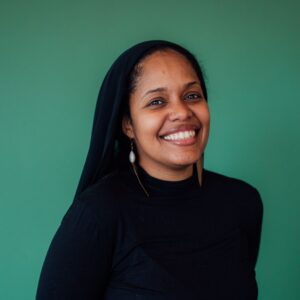
Day in the Life of a Philanthropy Strategist and Facilitator – Nadia Ahidjo

Day in the Life of a Major Gifts Officer features the workday routine of awesome fundraisers and is inspired by Kivi Leroux Miller’s and Kristina Leroux’s series for nonprofit communicators over on the Nonprofit Marketing Guide. 


Nadia works with philanthropies, non-profits, and social justice organizations
to navigate power, complexity, and change. She’s currently the Senior Advisor for Philanthropic Partnerships at the Black Feminist Fund. Outside the professional sphere, she is a short fiction writer,using storytelling to inspire emerging voices and bring creativity into organizational and social change spaces.

before 8 am – I try not to let urgency enter my spirit before I do. So no, I’m not checking emails first thing. That’s a boundary I’m still practising, but it matters. Early mornings are what I think of as my winter space—slow, quiet, and grounding. A lot of how I understand time comes from my spiritual practice and the communities I’m part of. As a Muslim, I’m held by the rhythm of prayer throughout the day. These pauses are intentional, embodied, and non-negotiable; they bring me back to what actually matters. They interrupt urgency and remind me that not everything is as pressing as capitalism would have us believe. There is always space to return, to reset, and to realign. As a Black feminist, I carry the teachings of Tricia Hersey and so many other thinkers who have shaped me. They remind me to move as my whole self, not fragment my life for work. As a governing circle member of The Circle on Philanthropy, I’m inspired by their seasonal pathways framework, which reminds me that time is cyclical—there are seasons for rest, emergence, action, and reflection. And once you open an email, you’re no longer in your own time—you’re in everyone else’s priorities.
 
8 am to 10 am – This is my spring energy, it’s where I try to channel clarity, emergence, and possibility. If I’m at my best, I protect this window for deep work. So anything that is strategy, big-picture thinking, and shaping how resources flow in ways that actually shift power. This is also where I practice what I learned from Shireen Motara by holding my work as one part of my life, not the centre of it. So I’m mapping my day alongside care responsibilities, family rhythms, and my own capacity. And I’m discerning early: what actually needs my full energy today? What can wait? I am privileged to work at the Black Feminist Fund where we have the space to lean into discernment and commitment to our work and modeling the abundance we advocate for on behalf of our movements..
 
10 am to 12 pm – This is where I start to open outward, it’s kind of my early summer. In this window I have meetings, conversations, and I connect with others via email and other ways. I guess you can call it my relational time. I’m also still thinking about how I show up in ways that don’t reproduce urgency culture. That’s something I’ve learned from leaders like Françoise Moudouthe who reminds me that even something as simple as drafting an email, sitting with it, and sending it later can shift the tone from pressure to intention. And honestly, I’m trying to take breaks that feel like care. Whether that’s food, stepping outside, or just pausing. Small interruptions that remind me I’m human and humans need snacks and community. I always acknowledge Gifty Edem Asare, who used to put in windows in my calendar to step away from my computer and take a break.
 
12 pm – 2 pm –This is full summer energy, you know how it is in the global minority world when the sun is out? We are doing, moving, responding so I lean into that energy for calls, relationship-building, etc. and always grounded in values. I believe moving resources is never just transactional; it’s relational, political, and deeply intentional so that’s how I think about my conversations with others in philanthropy in this window. This is also where I rely on structure. All the tools, systems, and practices I’ve learned from people like Izabelle Denizé around building workflows that help me track what matters without relying on memory or overwhelm. And again, I’m checking in with myself, if my energy dips, I shift to pieces of work that align. That’s part of resisting the grind, by honouring capacity instead of overriding it.
 
2 pm – 4 pm –This is my fall energy, when the leaves are starting to colour and fall, I lean into reflection, discernment, and integration. I’m reviewing, planning, and asking questions for the next day and beyond. What moved today? What didn’t? What actually matters next? Where was I disciplined in my work or not? Discernment is a practice I’ve really deepened through conversations with Tynesha McHarris, by asking myself not just can I do something, but should I do it now? Is it aligned? Is it necessary? I also think about what Hakima Abbas taught me, sitting with a piece of work after the first draft, asking deeper questions, letting it evolve into something more thoughtful, more aligned. I also think about accountability as I practiced it throughout my day. The way discipline is grounded in Black feminist praxis (please read Jessica Horn’s book on African Feminist praxis and the African Feminist Charter) has inspired me to find my own inner discipline guru. Sometimes reflections in this window don’t happen at the desk but during a walk, in stillness, or stepping away to breathe.
 
After 4 pm – I’m learning (slowly) that work has to end, especially because I work remotely. I don’t do this always perfectly, but keep it as an intention. Evenings are for my family, rest, and community. That return to winter is essential, and rest is not separate from the work, it is the work. Muslim prayer rhythms also guide me here, as the small pauses throughout the day help me transition, release, and not carry everything forward. If I prepare for tomorrow in this window, then it’s gentle. A quick list, a glance at my calendar, as I try not to re-enter urgency.
 
Anything else you’d like to add or wisdom to share?
Two things I return to: First: quality over quantity. I’m not here to produce endlessly. I’m here to move with intention, to think, to question, to deepen. That’s something I’ve learned across my feminist community, that taking time actually strengthens the work. Second: “Is it that deep?” That question saves me every time, and Vanessa Thomas reminds me every time my overachieving spirit begins to tip into urgency. Because most things are not as urgent as they feel. And I hold that alongside the teachings of Black feminist lineage that reminds us: we don’t have to earn our rest through exhaustion. Discipline, for me, is about alignment and being accountable to the work, to our communities, and to ourselves. I invite you to listen to this if this resonates with you: https://www.youtube.com/watch?v=01aI5xAZafw
 
What nourishes you outside of work? How do you take care of your well being?
For me, nourishment is about returning to myself and to community. The returning, no matter what tool I use for it, creates natural pauses in my day to breathe, to reflect, to let things go. It reminds me that my worth is not tied to output. I am also a writer, so I journal, reflecting as I read and write, and by being with people who hold me with care, are part of what nourishes me. You can read my most recent (funny) short story on journaling here: https://kalaharireview.com/new-year-new-me-49a0f44d9815 I’ve also learned that small things matter. On hard days, it might just be five minutes of something gentle like writing, sitting outside, or taking a nap (shout out to Sarah Diedro Jordão). I also think a lot about the environment, I live in one of the most beautiful parts of the world and always surrounded by light, space, beauty. These things shape how I feel and how I move when I take the time to notice it. Most importantly, I don’t treat care as something I earn after burnout. It’s something I build into my life consistently. Because if we’re serious about resourcing movements for the long term, then we have to practice that same sustainability within ourselves and model it for others.
Inspired to share about your typical day? It’s easy, just submit the form below 🙂 Thank you!

Sie sehen gerade einen Platzhalterinhalt von Standard. Um auf den eigentlichen Inhalt zuzugreifen, klicken Sie auf den Button unten. Bitte beachten Sie, dass dabei Daten an Drittanbieter weitergegeben werden.

Weitere Informationen